
Website Chatbots vs. AI Systems Trained on Your Business
By the Flon team · Published July 11, 2026 · Last updated July 11, 2026
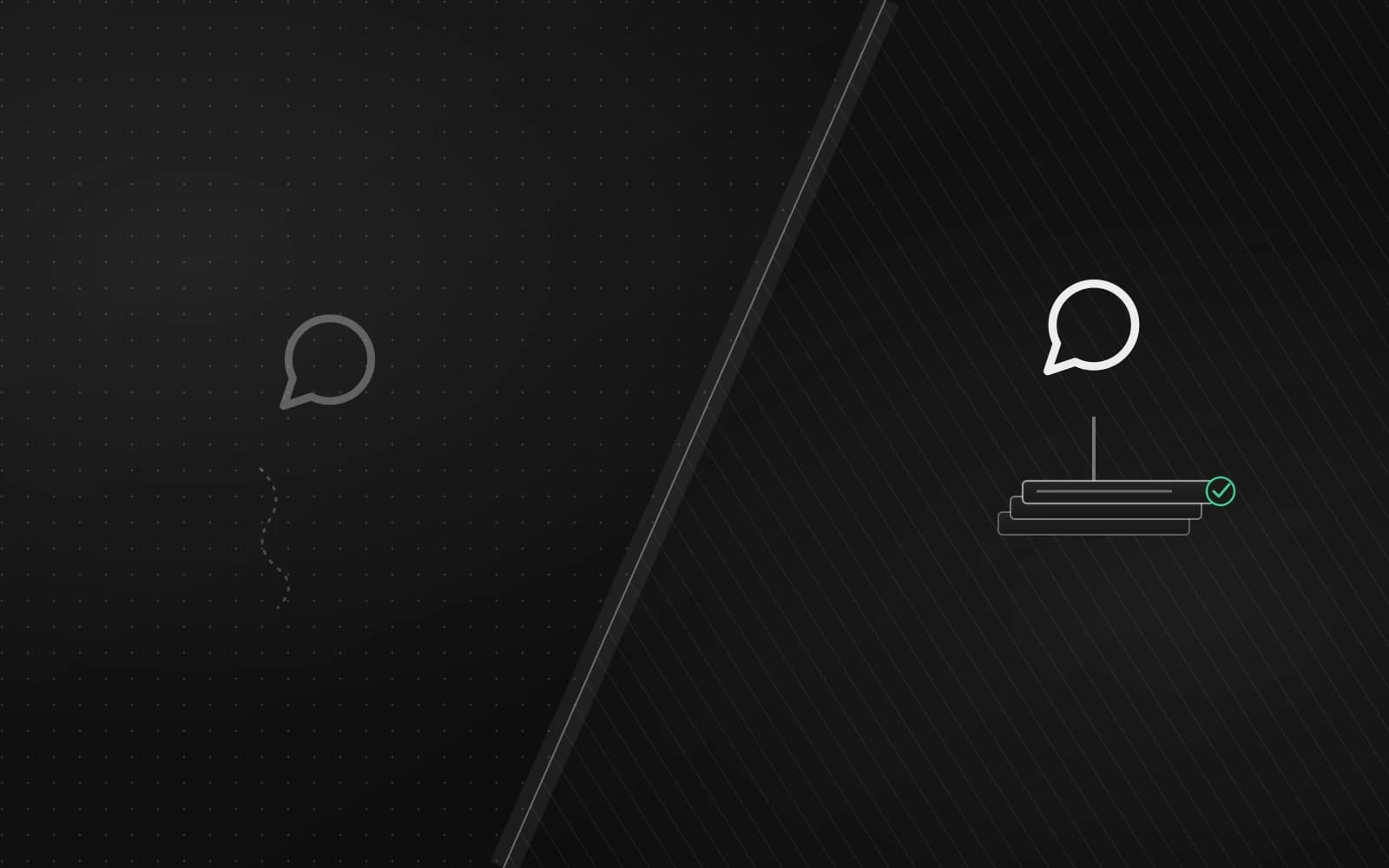
A generic website chatbot is a wrapper around a general-purpose model with your logo on it, with no real knowledge of your pricing, your booking rules, or when to hand off to a human. An AI system trained on your business — a customer-facing chat channel, or an internal knowledge assistant — is built from your actual knowledge base, can book appointments and escalate on defined rules, and ships with an agreed number attached. The difference between the two is most of the reason "chatbot" became a word people distrust.
What a generic chatbot is
Most website chatbots are a thin interface on top of a general model, sometimes fed a PDF or two of your FAQ. They can hold a conversational tone, but they don't reliably know your current pricing, your actual availability, or the edge cases your team handles by instinct. Ask one a specific question outside its training and it will often answer confidently and incorrectly, which is worse than not answering at all, because a visitor has no way to know the answer is wrong.
This is why chatbots earned a bad reputation. A tool that occasionally invents an answer, quotes a price that changed six months ago, or can't tell a real booking request from a general question erodes trust faster than having no chat widget at all.
What a trained AI system is
An AI system trained on the business, whether it faces customers or your own team, is built from your actual knowledge base: services, pricing, policies, escalation rules. It's evaluated before launch, so answers are checked against known-good responses rather than hoped to be accurate. It can book directly into your calendar, and it escalates to a human on rules you define, rather than guessing.
Critically, it ships with a single agreed metric (answer rate, response time, or bookings) and a monthly report against it, because a system that isn't measured isn't operated, it's just deployed and forgotten.
Comparison table
| Generic chatbot | Trained AI system | |
|---|---|---|
| Knowledge source | General model + maybe an FAQ upload | Your actual knowledge base: pricing, policies, services |
| Accuracy on specific questions | Unreliable, prone to confident wrong answers | Trained and evaluated against your real business |
| Books appointments | Rarely, or not at all | Yes, directly into your calendar |
| Escalates to a human | Rarely defined, often just "contact us" | Yes, on rules you set |
| Kept current after launch | Usually not, set and forgotten | Yes, we stay to run it, with monthly reporting |
| Evaluated before launch | Rarely | Yes, tested against known-good answers |
| Guaranteed metric | No | Yes, one agreed metric, reported monthly |
| Setup cost | Often near-$0, self-serve | Scoped and priced after a $1,900 Blueprint |
| Live in | Instant, but unreliable from day one | Weeks, on a fixed scope and price |
Why chatbots earned their bad reputation
The core failure mode is confidence without knowledge. A generic chatbot doesn't know what it doesn't know, so it fills gaps with plausible-sounding answers instead of escalating or saying "let me check." For a business, that means a visitor gets a wrong price, a wrong policy, or a promise the business never made, and the business finds out when the customer shows up expecting it.
A trained AI system is built the opposite way: escalation rules exist precisely because not every question should be answered by the system. Human-in-the-loop isn't a limitation bolted on afterward. It's part of the design from day one, and it's the single biggest reason a trained system doesn't accumulate the kind of reputation damage a generic chatbot does.
When a generic chatbot is honestly fine
We're not going to argue every chat widget needs to be a full trained system. That's not true, and pretending otherwise would cost this piece its credibility.
- Very low traffic sites. If your site gets a handful of visitors a week, the ROI on a trained system with booking and escalation logic isn't there yet. A simple FAQ chatbot, or no chatbot at all, is the right call.
- Pure FAQ, no booking or transaction. If visitors only ever need static information you'd happily put in a help doc (hours, location, a return policy), a lightweight chatbot or even a well-organized FAQ page does the job without needing training or evaluation.
- You're still figuring out what the business even offers. A trained system needs a real knowledge base to train on. An early-stage business still iterating on its offer may not have stable-enough answers yet for training to be worth doing. A generic chatbot (or no chatbot) is a reasonable placeholder until the offer settles.
- Budget genuinely isn't there yet. A trained system is an investment with a guaranteed metric behind it. If the budget for that doesn't exist yet, a free or near-free chatbot tool is better than nothing, with eyes open about its limits.
The honest verdict: a generic chatbot is a placeholder, not a solution, for any business where a wrong answer costs real money or trust. It's a reasonable placeholder for businesses that aren't there yet.
FAQ
What makes an AI system "trained on your business" different from a chatbot? It's built from your actual knowledge base (pricing, services, policies, edge cases), evaluated before launch, and updated as your business changes. A generic chatbot runs on a general model with little or no real knowledge of your specifics.
Can a trained AI system book appointments the way a chatbot can't? Yes. A trained chat channel is built against your calendar and booking rules and can confirm an appointment inside the conversation, not just collect contact information for a human to follow up.
Is a trained AI system more expensive than a chatbot tool? Yes, up front. A built system is scoped and priced after a $1,900 Blueprint, versus many chatbot tools that are free or near-free. The comparison that matters is cost per correct, converted answer, not sticker price.
Does a trained system ever give a wrong answer? Every AI system can. The difference is what happens next: a trained system is evaluated before launch and escalates uncertain questions to a human on defined rules, instead of guessing.
Who keeps the system accurate after launch? We stay to run it. Every system we build includes Flon Managed by default, with a one-page monthly report against the number we agreed it exists to move.
Related reading
- What is an AI receptionist?: definition and what "trained on a business" actually means.
- Company knowledge base (for AI): what belongs in the corpus a system trains on.
- Human-in-the-loop (HITL): why escalation rules matter more than raw model quality.
- The buyer's guide to governed AI: guardrails, evals, and audit trails, explained for buyers who can't afford a wrong answer.
Ready for a system your visitors can actually trust?
See what a custom system includes: the knowledge base, the evaluation, the booking logic, and the number behind it.